William Chester Minor’s death
The Surgeon of CrowthorneWilliam Chester Minor’s death in 1920 closed a life shaped by prolonged confinement, severe mental illness, and an extraordinary contribution to the Oxford English Dictionary. His final move out of the asylum system brought a change of surroundings but not a return to health; blindness soon deprived him of reading, one of his principal sources of pleasure, before he died at the age of eighty-five.
Illness and Long Confinement
Minor’s illness had become unmistakable in 1868, when army doctors judged him seriously unwell and Surgeon Hammond described his condition as monomania. The term reflected the period’s attempt to classify a disturbance focused on a particular subject; Hammond did not identify that subject in his report. Decades later, on 8 November 1918, a psychiatrist at St Elizabeths Hospital recorded a more specific diagnosis: dementia praecox, of the paranoid form. The change in terminology marked a shift away from the broad Victorian language of insanity, but it did not resolve what had caused Minor’s illness.
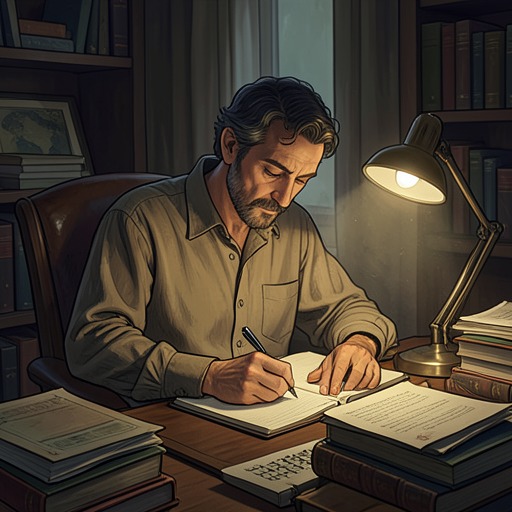
The account leaves that question open. It considers a possible inherited predisposition, Minor’s temperament and exposure to wartime violence, and the possibility that his years of confinement did not help him recover. These remain possibilities rather than a single established explanation. By contrast, the role of his dictionary work in his daily life is presented more concretely: its regular intellectual demands and the OED quotation slips appear to have given him a measure of relief from paranoia. When that work ceased to provide its former focus, his condition worsened.
Release and Final Months
In 1919, Minor’s nephew applied for his release from St Elizabeths Hospital and transfer to the Retreat, a hospital for elderly people with mental illness in Hartford, Connecticut. The army agreed, and the hospital board accepted the move. In November, after living within the asylum system since 1872, Minor left Washington for the last time.
He liked his new home, a mansion set among woods and gardens beside the Connecticut River. The change seemed to do him some good, but he remained unable to care for himself. His eyesight was failing rapidly; for months he could no longer read. The loss mattered especially because books and the sustained work of reading had been central to his life, including his long collaboration on the dictionary. His final months thus brought a quieter setting but also the removal of an activity that had given his days purpose.
Death and Burial
After a walk on a blustery early-spring day in 1920, Minor caught a cold that developed into bronchopneumonia. He died peacefully in his sleep on Friday, 26 March, aged eighty-five years and nine months. The account records the illness and date but does not portray his death as a resolution of the long uncertainty surrounding his mental illness.
There was little public notice. The New Haven Register published only two lines in its deaths column. The following Monday, Minor was buried in the family plot at Evergreen Cemetery, established by his missionary father, Eastman Strong Minor. His small, unadorned reddish-sandstone gravestone bears only his name. Nearby, an angel on a plinth looks upward beneath the engraved motto My Faith Looks Up to Thee.
The Dictionary and His Afterlife
Minor’s burial place sharpens the contrast between the scale of his scholarly labour and the obscurity of his death. A high chain-link fence surrounds Evergreen Cemetery, separating it from the surrounding poverty and placing it at a distance from Yale’s more formal surroundings. The grave itself offers little indication that Minor had become one of the Oxford English Dictionary’s most substantial contributors.
The dictionary was completed eight years after his death. Its twelve volumes defined 414,825 words and used 1,827,306 illustrative quotations; Minor alone had supplied scores of thousands. The work outlasted him, while the sparse notice of his death and the unmarked simplicity of his grave left his personal story largely outside public commemoration. The ending therefore joins two unequal measures of remembrance: a vast reference work to which he gave decades of attention, and a burial place bearing little more than his name.